H Upmann cigars, properly H. Upmann, come from one of the oldest houses in Havana. A German banker started the brand in 1844, and it is still known for smooth, refined, medium-strength smoke. This profile covers its history, its key sizes, its house style and its place in Malaysia.
The Cuban brand and its US namesake
As with several old Havana names, two brands now share this one. The original is Cuban, owned by the state and sold worldwide by Habanos S.A.
A second, non-Cuban H. Upmann is made for the American market by Altadis U.S.A., mostly in the Dominican Republic. It uses no Cuban tobacco. Since 2020, Altadis U.S.A. and a half share in Habanos have been held by companies tied to one investor group. Still, the two cigars stay separate. This profile covers the Cuban brand.
History of H Upmann cigars
Herman Upmann arrived in Havana in the 1840s on business for a family trading firm from Bremen. He soon saw the promise of cigars. In 1844, according to Habanos, he founded both a bank and a cigar factory.
The cigars did well. Habanos says the brand won gold medals at eleven international fairs in the 19th century, and the medals still decorate its boxes. The brand is also credited with popularising cedar boxes for shipping cigars, a habit the whole trade later adopted.
Then the business ran into trouble. The family firm went bankrupt in 1922, and the British agent J. Frankau & Co. bought the brand and factory at auction. Next, by 1937, Menéndez, García y Cía had taken over, the same partners who had launched Montecristo. Finally, the state nationalised the company after the revolution.
A famous order
One story follows the brand everywhere. Before President Kennedy signed the US embargo in 1962, he reportedly asked his press secretary, Pierre Salinger, to gather about 1,200 H. Upmann cigars. Salinger told the tale himself years later.
How it is made
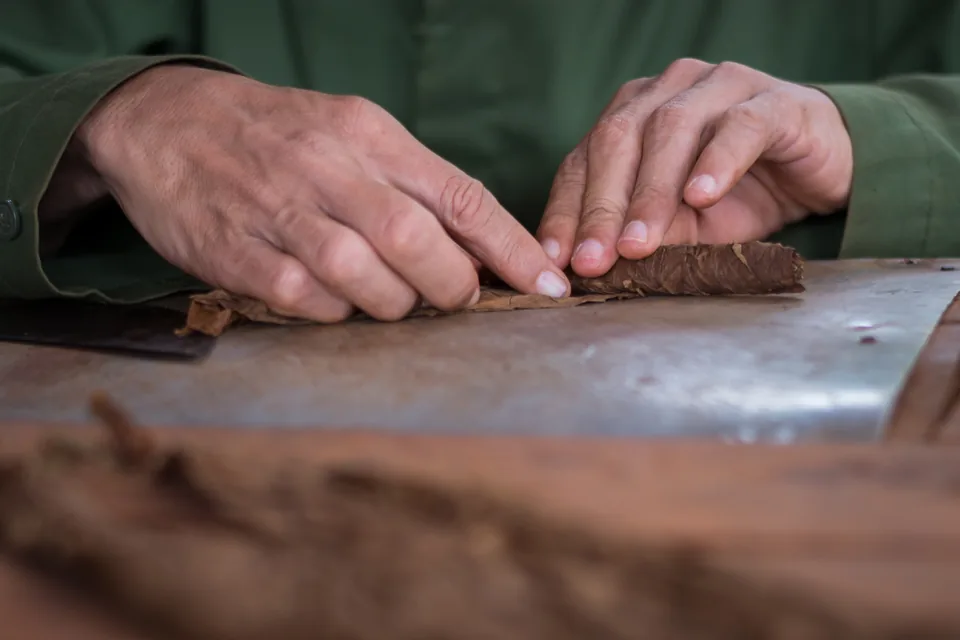
All long-filler H. Upmann cigars are made totally by hand with leaf from the Vuelta Abajo. As with other Habanos, the factory that rolls a particular size can change over time.
Notable lines and sizes
The modern range centres on the Magnum family. The Magnum 46 is the classic; the Magnum 50 followed in 2008 and the Magnum 54 in 2016. Short smokes are covered by the Half Corona, added in 2011.
| Cigar | Length × ring gauge | Shape |
|---|---|---|
| Half Corona | 90 mm × 44 | Short petit corona |
| Petit Coronas | 129 mm × 42 | Petit corona |
| Connossieur No. 1 | 127 mm × 48 | Corona extra |
| Magnum 46 | 143 mm × 46 | Corona gorda |
| Magnum 50 | 160 mm × 50 | Double robusto |
| Upmann No. 2 | 156 mm × 52 | Torpedo (pirámide) |
| Sir Winston | 178 mm × 47 | Churchill |
For a closer look at the smallest of these, read our H. Upmann Half Corona review. The cigar sizes guide explains how the shapes compare.
House style and flavour
In general terms, H. Upmann is smooth and polished. Habanos calls it a “refined” medium flavour with light to medium strength. Smokers commonly describe cedar, light cocoa, toasted bread, a little honey and a soft, creamy finish.
So the brand often suits daytime smoking or a first Cuban cigar. Of course, age and storage change things, so these notes are a guide only.
Strengths and criticisms
On the plus side, the brand has a long record, a calm and balanced profile and a sensible range of sizes. The Magnum 46 in particular has a loyal following.
That said, some smokers find the style too gentle, or even flat, next to bolder Cuban brands. Others report uneven draw and burn in some boxes, a common complaint across large Habanos brands.
H. Upmann in Malaysia
Outside the US, H Upmann cigars on the shelf are normally the Cuban ones. In Malaysia, Habanos cigars come in through The Pacific Cigar Company, the official distributor for the Asia-Pacific region. Real boxes carry the Habanos warranty seal; our guide to counterfeit cigars covers the other checks.
In addition, Act 852 bans tobacco advertising and online sales; see our page on Act 852 and cigar law. Malaysia’s damp air and air-conditioned rooms both affect cigars, so our cigar storage guide is a useful next step. Lighter cigars are still not safe, as our page on cigar health risks explains.
Where to read more
- Cuban cigars: the pillar guide to Habanos
- Montecristo: the brand born in the Upmann factory
- Cuban cigar history: from private houses to state brands
- Cigar brands: the full directory
Frequently asked questions
Who founded H. Upmann?
Herman Upmann, a German banker, set up both a bank and a cigar factory in Havana in 1844. The bank eventually closed, but the cigar brand survived and passed through several owners.
Is H. Upmann a strong cigar?
No. Habanos rates it light to medium, so it sits on the gentler side of Cuban cigars. Our cigar strength chart shows how that compares.
What is the H. Upmann Half Corona?
A short petit corona of 90 mm by 44 ring gauge, added in 2011 for shorter smoking breaks. Our Half Corona review covers it in detail.
Did President Kennedy smoke H. Upmann?
The story is well documented. Before signing the Cuban embargo, Kennedy reportedly had his press secretary, Pierre Salinger, gather about 1,200 H. Upmann cigars.